The Back-Office Guide for Fund Accountants Worldwide
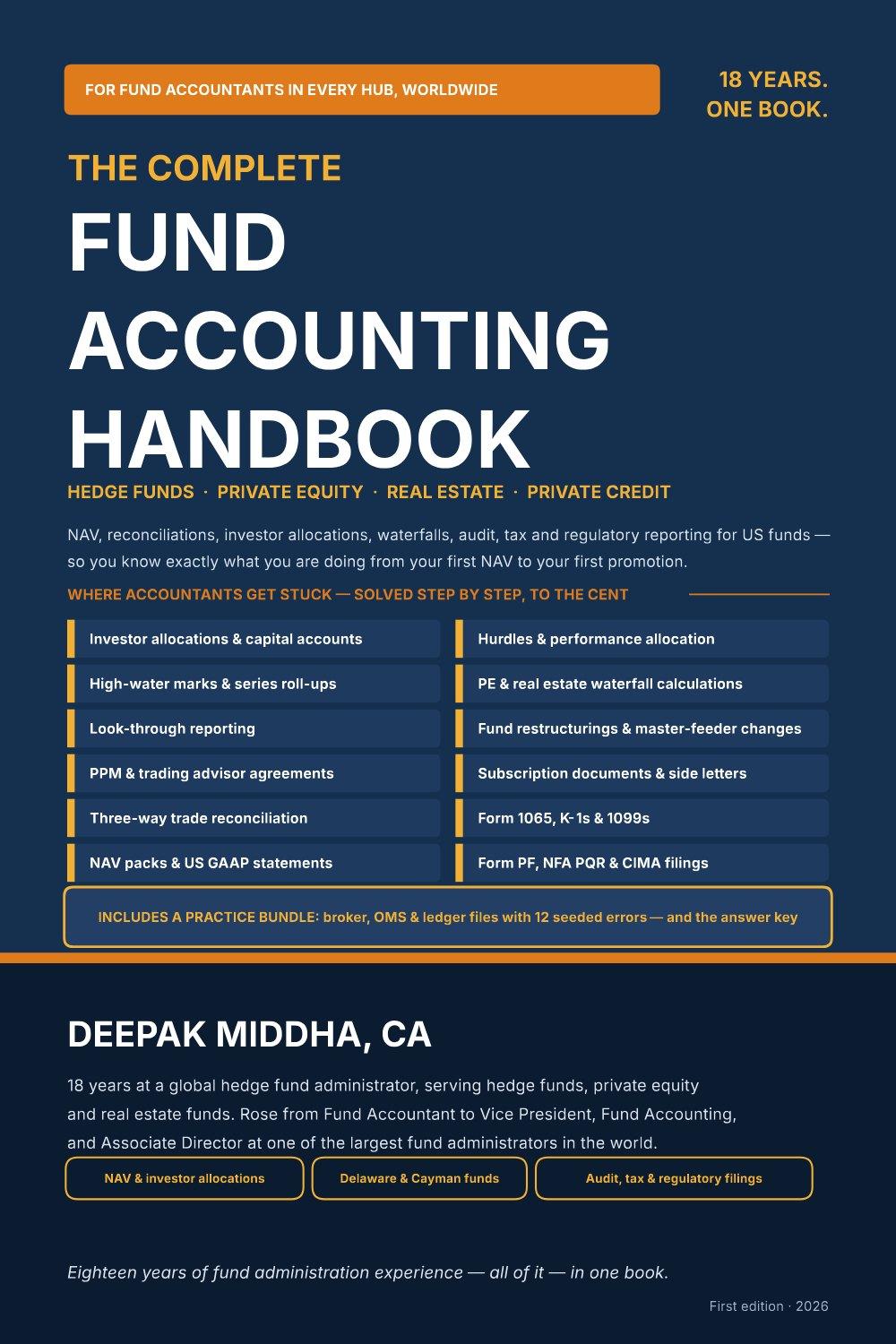
The Complete Fund Accounting Handbook
Hedge Funds, Private Equity and Real Estate Funds — NAV, Reconciliations, Investor Allocations, Waterfalls, Audit, Tax and Regulatory Reporting for US Funds
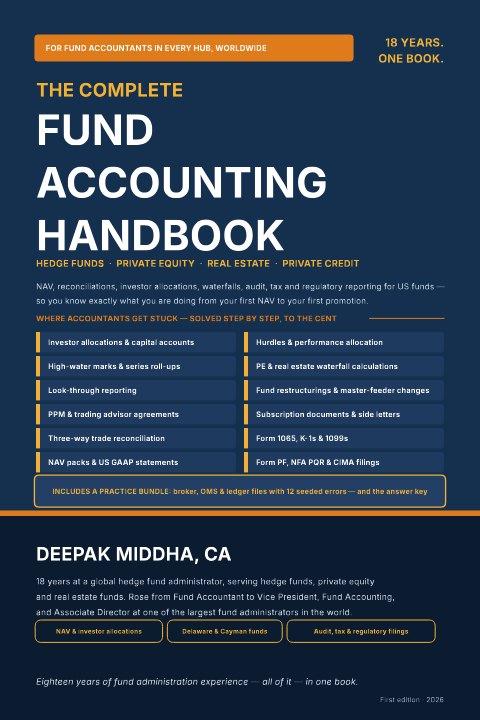
PDF · 293 pages · First edition 2026 · includes practice bundle
₱499
By Deepak Middha, CA
Inside: 100 interview questions with model answers and a practice bundle with 12 seeded errors.
or read the free sample ↓ (18 pages: front matter, contents and Chapter 1)
Digital product, final sale. Replacement or refund if the file is not delivered, will not open, or you were charged twice.
Regulatory and tax statements current as of 15 November 2026
Quick answer
The Complete Fund Accounting Handbook is a 293-page PDF by Deepak Middha, a Chartered Accountant with 18 years in fund administration. It explains how US hedge funds, private equity and real estate funds are accounted for (NAV, reconciliations, investor allocations, waterfalls, audit, tax and regulatory reporting) and how to get hired to do the work. It is written for accounting graduates, working fund accountants and team leads. It costs ₱499, and a free 18-page sample is available.
Get the free 18-page sample by email
Is this for me? Three quick questions
The answer uses the reading paths the book itself gives in “How to use this book”.
By Deepak Middha, Chartered Accountant · page reviewed
Key points
- Scope: the back-office cycle for US hedge, private equity, real estate and private credit funds, from the trade file to the NAV pack, audit, tax and filings.
- Who it is for: accounting graduates, fund accountants with one to three years of experience, and team leads.
- What is included: 4 parts, 25 chapters and 15 appendices in 293 pages, 100 interview questions with model answers, and a practice bundle with 12 seeded errors and an answer key.
- Price: ₱499 for the PDF and the bundle; final sale, with a replacement or refund if the file fails or you were charged twice.
- Education only: not legal, tax, investment or accounting advice, and no promise of a job.
Who this fund accounting book is for, and who it is not for
The book names three readers and gives each a reading path. If you are not one of them, another resource will serve you better.
It is for
- The graduate or young accountant. Read Parts 1 and 2 closely, then go straight to Chapter 24.
- The fund accountant with one to three years of experience. Read the whole book in order. Parts 3 and 4 are written for you.
- The team lead or training manager. Read the chapters in sequence over an eight to ten week onboarding, one or two chapters a week, with the worked examples used as exercises.
It is not for
- Readers who want Philippine tax or bookkeeping rules. The book covers US fund accounting. For the BIR, see our free tax guides and calculators.
- Investors looking for stock picks. It explains how funds are accounted for in the back office, not what to buy.
- Anyone expecting a job guarantee. It prepares you for the tests and interviews; the hiring decision is the employer’s.
Fund accounting careers in the Philippines: what the book says
The Philippines is one of the two largest hubs where US fund accounting is done. Everything below comes from the book: Appendix H and the chapters on the career ladder and on hiring.
| Topic | What the book says |
|---|---|
| Where the work is | Concentrated in Manila (Bonifacio Global City, Ortigas, Makati and Alabang), with Cebu as the growing second hub. |
| Who is hired | BS Accountancy and BSBA graduates. CPA board passers are strongly preferred and often start a level higher. |
| When campus hiring runs | It follows the CPA board exam results (May and October) and the graduation months (March and June). |
| Working hours | US-hours shifts are more common than in India, because Manila is 12 or 13 hours ahead of New York. |
| The entry role | Level 1: Fund Accountant, Associate, Analyst or Fund Administrator (0–3 years), paid for accurate, timely trade capture, reconciliations, pricing exceptions, accruals and draft NAV components. |
| Indicative entry pay | ₱360,000 – ₱720,000 a year, total fixed. Indicative, from the book’s Appendix H: the author’s illustrative 2026 estimates, not a survey and not a promise. Verify current ranges with recruiters and employers’ postings. |
The book prepares you for the written test most administrators set, the four interview rounds and your first 90 days. Writing your first application? Our application letter template and biodata format are free.
What you will learn, part by part
The book follows the order of the work, and every Part 2 example uses one fund, tied out to the cent in Appendix K.
| Part | Chapters | What you can do after it |
|---|---|---|
| Part 1: The Industry You Are Joining | 1–5 |
|
| Part 2: The NAV Cycle, Step by Step | 6–16 |
|
| Part 3: Beyond the NAV: What the US Client Also Needs | 17–21 |
|
| Part 4: Getting the Job and Growing in It | 22–25 |
|
What is included in the PDF and the practice bundle
4
parts
25
chapters
15
appendices
293
pages
100
interview questions with model answers
247
glossary terms
10
solved exercises
8
operational failures investigated
The practice bundle
Synthetic files for one month-end close of the book’s example fund, with 12 seeded errors, one judgement item and an answer key giving each error’s NAV impact in dollars and basis points.
| File | What it contains |
|---|---|
| A_ | The manager's trade file for the day |
| B_ | The prime broker's trade, position and cash files |
| C_ | What the fund accounting system has booked |
| D_ | Two vendors' prices with stale flags |
| E_ | The day's corporate action notices |
| F_ | The investor register, dealing events and side letters |
| G_ | Extracts from the fee agreements |
| answer_ | The twelve errors, where each is found, its NAV impact and the correction, plus a suggested client email |
The 15 appendices
| Appendix | Title | Page |
|---|---|---|
| A | Glossary (247 terms) | 236 |
| B | Sample Monthly NAV Summary | 246 |
| C | Sample Capital Call Notice | 247 |
| D | Sample Distribution Notice and Waterfall Worksheet | 248 |
| E | Performance Fee Worksheet (Series Method) | 249 |
| F | Daily and Month-End Checklists | 250 |
| G | Annual Regulatory and Reporting Calendar | 251 |
| H | Country Notes: India, the Philippines and Indicative Pay | 252 |
| I | Further Reading and Reference Sources | 256 |
| J | Chapter-End Questions: Where the Answers Are | 257 |
| K | The Running Example: Lakeshore, One Month from Trade to Tax Package | 268 |
| L | Eight Operational Failures, Investigated | 273 |
| M | Primary Sources and Verification Dates | 286 |
| N | The Companion Practice Bundle | 289 |
| O | Ten Solved Exercises | 291 |
+See the full table of contents (25 chapters)
Part 1 — The Industry You Are Joining
- Chapter 1How a US Fund Actually Works9
- Chapter 2Hedge Fund, Private Equity, Real Estate: Three Businesses, Three Accounting Rhythms18
- Chapter 3Delaware and Cayman: Why There Are Always Two or Three Entities25
- Chapter 4Reading the Fund Documents35
- Chapter 5The Fund Administrator Business44
Part 2 — The NAV Cycle, Step by Step
- Chapter 6Trade Capture and the Daily Cycle56
- Chapter 7Derivatives, Short Positions and Leverage: The Entries That Trip People Up64
- Chapter 8Reconciliations: Cash, Positions, Trades73
- Chapter 9Pricing and Valuation89
- Chapter 10Income, Expenses and Accruals96
- Chapter 11Management Fees, Performance Fees and Incentive Allocation103
- Chapter 12Investor Allocations and the Capital Account118
- Chapter 13Producing and Reviewing the NAV Pack127
- Chapter 14Private Equity Specifics136
- Chapter 15Real Estate Fund Specifics146
- Chapter 16Private Credit Fund Specifics154
Part 3 — Beyond the NAV: What the US Client Also Needs
- Chapter 17Investor Servicing and Transfer Agency160
- Chapter 18Regulatory and Filing Calendar167
- Chapter 19Audit, Year-End and US GAAP Financial Statements177
- Chapter 20Tax Season from the Back Office186
- Chapter 21Working with the US: Communication That Gets You Promoted193
Part 4 — Getting the Job and Growing in It
- Chapter 22The Roles and the Ladder200
- Chapter 23Employers and How They Hire206
- Chapter 24The Interview: 100 Questions with Model Answers215
- Chapter 25Your First 90 Days230
Where accountants get stuck, and where the book solves it
The twelve topics on the cover, and where each is worked through step by step.
| Where accountants get stuck | Where the book solves it |
|---|---|
| Investor allocations & capital accounts | Chapter 12; Appendix K |
| Hurdles & performance allocation | Chapter 11 |
| High-water marks & series roll-ups | Chapter 11; Appendix E; Exercise 2 |
| PE & real estate waterfall calculations | Chapters 14 and 15; Appendix D; Exercise 5 |
| Look-through reporting | Chapters 3 and 20; Appendix L |
| Fund restructurings & master-feeder changes | Chapter 3 (structures and variations); Chapter 5 (onboarding a new fund) |
| PPM & trading advisor agreements | Chapter 4 |
| Three-way trade reconciliation | Chapter 8; the practice bundle |
| NAV packs & US GAAP statements | Chapters 13 and 19 |
| Subscription documents & side letters | Chapters 4 and 17 |
| Form 1065, K-1s & 1099s | Chapter 20 |
| Form PF, NFA PQR & CIMA filings | Chapter 18 |
This book vs on-the-job training vs a paid fund accounting course
Many readers combine these. Course details come from the book’s Chapter 23; course prices vary, so we do not quote them.
| This book | On-the-job training only | A paid course | |
|---|---|---|---|
| Cost | ₱499, one time | No fee, but you need the job first | Varies by institute |
| Time | Self-paced; for a training batch the book suggests 8–10 weeks at one or two chapters a week | Months, on whichever funds you are assigned | Four to twelve weeks, per the book’s Chapter 23 |
| What it covers | The whole cycle across hedge, PE, real estate and private credit funds, plus audit, tax, filings, hiring and interviews | What your own team’s funds need, as it comes up | Varies; the book says it covers the content of most such courses |
| What it does not do | No live instructor, no placement, no certificate, no job guarantee | Rarely explains the reasons behind the procedure | Quality ranges from excellent to poor; the book suggests asking which employers hired the last three batches |
Read the free sample first
The sample is 18 pages: the cover, “Why this book”, the title and copyright page, About the author, How to use this book, the full contents and the complete Chapter 1. It arrives by email as a download link, so you can judge the writing and the level before you buy.
Buy the fund accounting handbook
The Complete Fund Accounting Handbook
PDF · 293 pages · First edition 2026 · includes practice bundle
₱499
What happens after payment
- Secure card payment through Stripe or payment through PayPal; your card details never touch Sulat.ph
- The PDF and the practice bundle arrive by email within minutes
- Download links stay valid for 30 days and 10 downloads, and are replaced on request
- Corrections to this edition are sent to buyers free
Digital product, final sale; see our terms for digital purchases. Lost your link? Get a new one.
Frequently asked questions
+What format is the fund accounting handbook, and which devices can I read it on?
It is a 293-page PDF in a 6 × 9 inch page size, so it reads well on a phone, tablet, laptop or e-reader that opens PDF files. The practice bundle comes as a ZIP of CSV spreadsheet files and a Markdown answer key, which open in Excel, Google Sheets or any text editor.
+How does delivery work after I pay?
After the payment provider confirms your payment, our server emails a download link for the PDF and the practice bundle to the address you paid with, usually within minutes. The same links appear on the thank-you page. Links work for 30 days and 10 downloads; if they run out, request a fresh link on the resend page.
+Can I print the PDF?
Yes. You may print a copy for your own study, and many readers like to work the solved exercises and checklists on paper. The book is copyrighted by the author, so sharing, uploading or reselling the file or printed copies is not permitted. Team leads who want copies for a batch can email the author.
+Is the book specific to the Philippines?
No. It is about accounting for US investment funds, work that is done in hubs worldwide, including Manila and Cebu. Appendix H adds country notes for the Philippines: where the work is, who is hired, the campus calendar and indicative pay. It does not cover Philippine tax or bookkeeping rules; our BIR tax guides do.
+Do I need accounting experience to use the book?
You need basic accounting: debits and credits, accruals and a trial balance. You do not need any fund experience. The book starts with what a US fund is and why it needs an administrator, and the worked examples use deliberately simple numbers so the mechanics are visible. Chapter 1 is in the free sample, so you can check the level first.
+Does the book guarantee me a job as a fund accountant?
No. No book can promise a job, a salary or a promotion. What it does is prepare you for what employers test: the written test, the four interview rounds and 100 interview questions with model answers. It also gives you a four-week readiness checklist and a practice bundle so you have done the work before your first day.
+What is the practice bundle?
A set of synthetic data files that reproduce one month-end close of the book's example fund: the manager's trade file, the prime broker's trade, position and cash files, the ledger, prices, corporate actions, the investor register and fee terms. It hides 12 seeded errors and one judgement item. The answer key shows each error's NAV impact in dollars and basis points.
+Can I get a refund on the fund accounting book?
It is a digital download, so sales are final once the file is delivered. You get a replacement or a full refund if the file was not delivered, will not open, or you were charged twice. Email deepak@wealthbuildingacademy.net with the email address you paid with, and we will sort it out.
+Will I get an official receipt or invoice?
You get the payment provider's receipt: Stripe emails a receipt for card payments, and PayPal emails its own transaction receipt. These are payment receipts from the provider. The book is sold by Wealth Building Academy LLC, a US company, so Sulat.ph does not issue BIR-registered official receipts or VAT invoices.
+How do I ask the author a question about the book or the job?
Email deepak@wealthbuildingacademy.net. Deepak Middha reads every message and replies to as many as he can, whether the question is about a chapter, a fund accounting career, the interview or the practice bundle. If you find an error in the book, the same address takes corrections, and verified corrections go to buyers free.
Related on Sulat.ph
More books: the Sulat.ph Library. Questions: deepak@wealthbuildingacademy.net.