In short
- What it is
- A sworn statement that you have actual care and custody of a minor, usually because the parents are abroad, deceased or absent.
- What it is not
- A court appointment. Only a Family Court can appoint a legal guardian under the Rule on Guardianship of Minors.
- Who executes it
- A grandparent, an adult sibling, or the adult who is actually raising the child, under the substitute parental authority rules of the Family Code.
- Typical uses
- School enrolment and signing school forms, medical consent, DSWD, barangay and scholarship requirements, and supporting a minor's passport or travel paperwork.
- Typical cost
- About ₱100–₱300 for notarisation.
Skip the typing. Answer a few questions and download a print-ready PDF or Word file — free.
Generate your affidavit of guardianship →Full affidavit of guardianship sample
For a grandparent with actual custody of a minor whose parents are working abroad. Replace everything in [brackets].
✏️ Click to fill this in with your details →REPUBLIC OF THE PHILIPPINES )
CITY OF [DAVAO] ) S.S.
x----------------------------------------x
AFFIDAVIT OF GUARDIANSHIP
I, [LOURDES M. TOLENTINO], of legal age, widow, Filipino, and a resident of [34 Quimpo Boulevard, Barangay Bucana, Davao City], after having been duly sworn in accordance with law, hereby depose and state that:
1. I am the maternal grandmother of [MIGUEL T. REYES], a minor, [nine (9)] years old, born on [21 February 2017] in [Davao City], as shown by his Certificate of Live Birth issued by the Philippine Statistics Authority, a copy of which is attached;
2. The parents of the said minor, [RAMON P. REYES] and [CLARISSA T. REYES], have been [working in Dubai, United Arab Emirates, since June 2024], and before leaving entrusted the said minor to my care and custody, as shown by [their letter of consent dated 02 June 2024], a copy of which is attached;
3. Since [10 June 2024] the said minor has lived with me at the above address, and I have since exercised actual care and custody over him, providing for his food, shelter, clothing, education and medical needs, with the knowledge and consent of his parents;
4. I am executing this affidavit to attest that I am the person presently responsible for the said minor, for the purpose of [enrolling him at Davao City Central Elementary School for School Year 2026–2027, signing his enrolment and school documents, and attending to his school requirements on behalf of his parents], and for whatever legal purpose it may serve;
5. I undertake to inform the said school of any change in the custody of the minor, and I understand that this affidavit attests to my actual custody of the minor and does not take the place of a guardianship appointed by a court.
IN WITNESS WHEREOF, I have hereunto set my hand this ____ day of __________, 20____, at [Davao City], Philippines.
______________________________
[LOURDES M. TOLENTINO]
Affiant
SUBSCRIBED AND SWORN to before me this ____ day of __________, 20____, at [Davao City], affiant exhibiting to me [her Senior Citizen ID No. 112233] as competent evidence of identity.
______________________________
Notary Public
Doc. No. ______;
Page No. ______;
Book No. ______;
Series of 20____.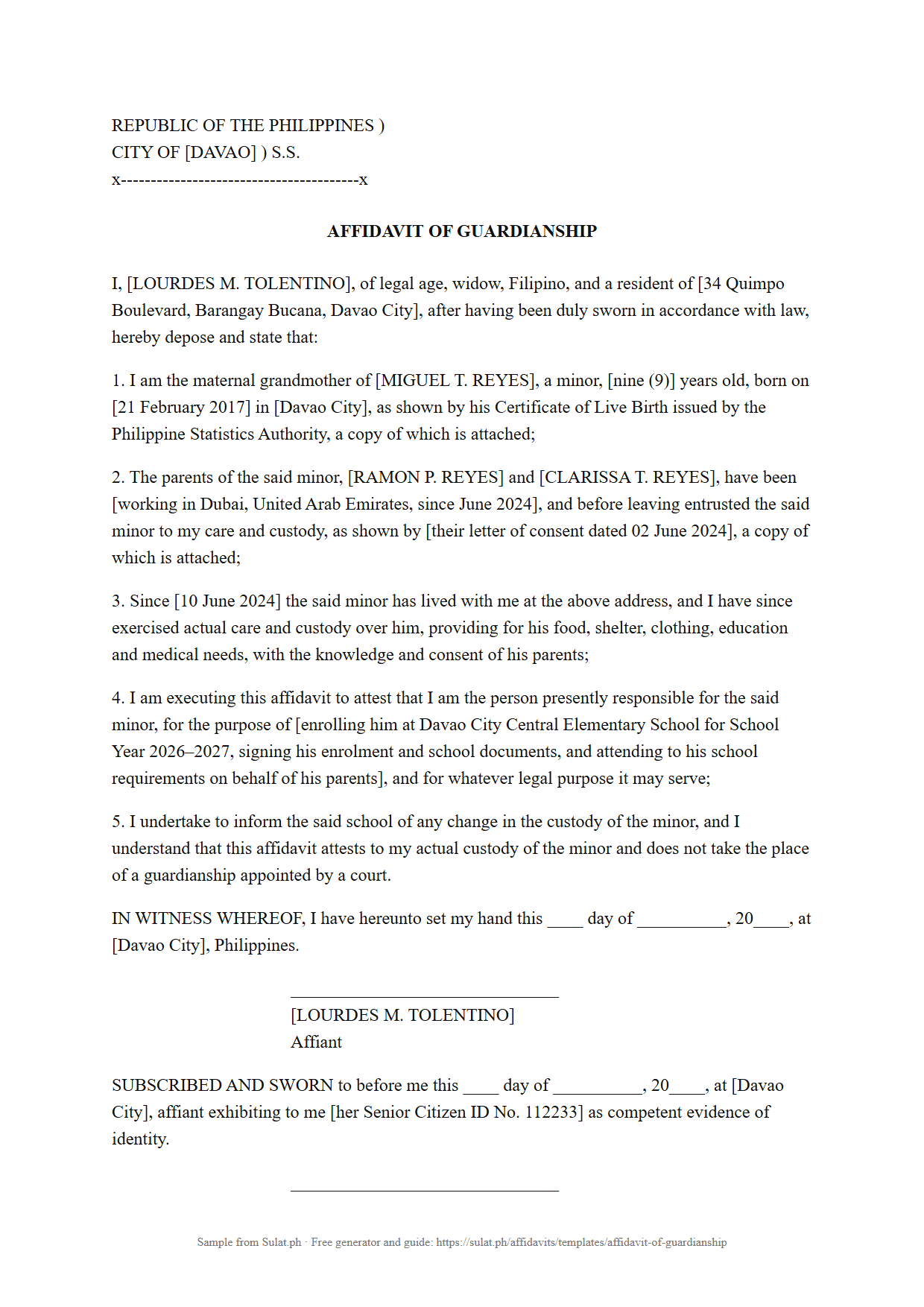
Download the affidavit of guardianship sample
The exact text shown above, laid out on A4 with a one-inch margin, ready to print or edit. Free, no email required.
What an affidavit of guardianship is, and what it is not
An affidavit of guardianship is a sworn statement by the adult who is actually raising a child that they have the child's care and custody, why, and since when. Schools, clinics, barangays and agencies ask for it when the person in front of them is not the parent on the birth certificate, because they need someone to sign for the child and to be answerable for the signature.
It is not a court order and it does not make you the child's legal guardian. Under article 210 of the Family Code parental authority cannot be renounced or transferred except in the cases the law allows, and the appointment of a guardian over a minor's person or property is a judicial act under the Supreme Court's Rule on Guardianship of Minors. What the affidavit documents is substitute parental authority, which the Family Code itself gives to certain people when the parents are absent, without any court involvement, and which is enough for the everyday decisions a school or a clinic needs.
Who can execute one: the Family Code's order
Article 216 of the Family Code says who exercises substitute parental authority in default of the parents or a judicially appointed guardian, and in what order. The affidavit should put you in one of these categories expressly.
| Order | Who | Condition | Say in the affidavit |
|---|---|---|---|
| 1 | The surviving grandparent | Any grandparent; where both lines survive, the parents' choice or the court's | Your relationship through the mother or the father, with the birth certificates that trace it |
| 2 | The oldest brother or sister over twenty-one | Unless unfit or disqualified | Your age, that you are the eldest sibling of the minor, and that the grandparents are deceased or unable |
| 3 | The child's actual custodian over twenty-one | Unless unfit or disqualified | How the child came into your care, since when, and with whose consent |
Article 214 covers the case of death, absence or unsuitability of both parents, where parental authority goes to the surviving grandparent. Article 218 gives schools and their teachers special parental authority over a child while in their custody, which is why a school can act in an emergency even without your affidavit.
When you will be asked for an affidavit of guardianship
| Office | Why they ask | What they usually also want |
|---|---|---|
| School, on enrolment and for signing school forms | DepEd's enrolment policy has the parent or guardian sign the enrolment form, report cards and consent slips | The child's PSA birth certificate, your ID, and the parents' letter of consent or SPA where they are abroad |
| Clinic or hospital | Consent for treatment of a minor comes from the parent or the person responsible for the child | Your ID; in an emergency they will treat first and ask later |
| DSWD, for a travel clearance or a social case study | The clearance process asks who the child lives with and on whose authority | The parents' consent, proof of relationship |
| Barangay, for a certificate of residency, indigency or solo-parent-type assistance | To record who is responsible for the child in the household | Proof of residence |
| Scholarship bodies, 4Ps and other benefits | To identify the adult who receives the grant on the child's behalf | The child's school records, proof of relationship |
| DFA, for a minor's passport | A minor applies with a parent or with an adult carrying the parents' authority | The DFA's own checklist controls; expect an SPA from the parents, consularised if executed abroad, and the DFA's affidavit of support and consent form, rather than this affidavit on its own |
| Banks, SSS, GSIS, PhilHealth, insurers, for a minor's money or property | Money and property of a minor are a guardianship-of-property matter | Usually a court appointment: see the table below |
Affidavit of guardianship, SPA from the parents, or court guardianship
These three are asked for interchangeably at counters and they are not interchangeable. The question is whether the parents are available to give authority, and whether the matter involves the child's property.
| Situation | The right document | Why |
|---|---|---|
| Parents alive and reachable, but abroad or away; everyday matters such as school and clinic | A Special Power of Attorney from the parents naming you, consularised if signed abroad, plus your affidavit of guardianship | The parents still hold parental authority and can delegate specific acts; your affidavit explains the custody on the ground |
| Parents deceased, missing or unable; everyday matters | Your affidavit of guardianship under articles 214 and 216 | Substitute parental authority arises by law; the affidavit documents it |
| Any situation where the child's property, money or a claim is involved: an inheritance, insurance or SSS death benefit, a bank account above a trivial sum, a sale of the child's land | A petition for guardianship in the Family Court under A.M. No. 03-02-05-SC, resulting in letters of guardianship | Only a court-appointed guardian can receive, manage or dispose of a minor's property; agencies and registries will insist on the court order |
| Parents alive and dealing with the child's own property | The parents, as legal guardians of the child's property under article 225, with a bond where the property or annual income exceeds ₱50,000 | No court appointment is needed for a parent, but the bond and court approval of a sale still apply |
A court guardianship petition is filed in the Family Court of the province or city where the minor lives, by a relative or other person on the minor's behalf, and names the ward, the property and the proposed guardian. It costs filing fees, a bond and usually a lawyer, and takes months; that is why offices accept an affidavit for everything that does not involve the child's property.
How to fill it in
- 1
Describe yourself and the child, with the documents that connect you
Your full name, age, civil status and address; the child's full name, age and date and place of birth; and the relationship, with the PSA birth certificates that trace it attached. A grandmother through the mother attaches the child's birth certificate naming the mother and the mother's birth certificate naming her.
- 2
Say where the parents are and why they are not acting
Working abroad since a date, deceased on a date with the death certificate attached, whereabouts unknown since a date, or incapacitated. This paragraph is what puts you within article 214 or 216, so make it factual and specific.
- 3
Say since when the child has lived with you, and with whose consent
The date the child came into your care and the document that shows the parents agreed: a letter, an SPA, a message exchange printed out, or, where they are deceased, the death certificates. If there was no formal handover, say how it happened.
- 4
State what you actually provide
Food, shelter, clothing, schooling, medical care. This is the custody the law looks at, and it is what a school or clinic is relying on.
- 5
Name the purpose and the office
Enrolment at a named school for a named school year, consent to treatment at a named hospital, the DSWD field office handling a clearance. An affidavit for whatever legal purpose only is weaker and is more often questioned.
- 6
Keep the honest limit in
The clause that the affidavit attests to actual custody and does not take the place of a court-appointed guardianship is there to stop the document being used for what it cannot do, and offices that know the law read it as a sign the affidavit was drafted properly.
Legal basis: Family Code of the Philippines, arts. 209–210 (parental authority and its non-transferability), 212 and 214 (death, absence or unsuitability of parents), 216 (substitute parental authority: surviving grandparent, oldest sibling over 21, actual custodian over 21), 218 (special parental authority of schools), 220–221 (rights and duties of those exercising parental authority) and 225 (parents as guardians of the child's property; bond where the property or annual income exceeds ₱50,000); Rule on Guardianship of Minors (A.M. No. 03-02-05-SC, effective 1 May 2003); DepEd Order No. 3, s. 2018 (Basic Education Enrollment Policy); 2004 Rules on Notarial Practice (A.M. No. 02-8-13-SC); Revised Penal Code art. 183 (perjury).
Affidavit of guardianship in Tagalog
In Filipino the document is a Sinumpaang Salaysay ng Pangangalaga or Sinumpaang Salaysay ng Pagiging Tagapag-alaga. The phrases that carry the legal weight are nasa aking pangangalaga at kustodiya (in my care and custody), mula pa noong (since), nang may kaalaman at pahintulot ng kanyang mga magulang (with the knowledge and consent of the parents), and tinutustusan ko ang kanyang pagkain, tirahan, pananamit, pag-aaral at pangangailangang medikal (I provide for his or her food, shelter, clothing, schooling and medical needs). Public schools and barangays accept a Filipino affidavit readily; the generator can draft one in Filipino if you ask it to.
What if…
- 1
…the school insists on a court order
For enrolment it does not need one, and DepEd's enrolment policy contemplates a guardian signing. Show the affidavit with the parents' consent or SPA attached and ask the principal which specific document is missing. Escalate to the schools division office if a child is being kept out of school over paperwork.
- 2
…the child has an inheritance, an insurance claim or an SSS death benefit
This is property, and an affidavit will not be enough. File a petition for guardianship in the Family Court; the Public Attorney's Office handles these for qualified clients. Until letters of guardianship issue, the money stays with the agency or in court.
- 3
…the parents come back and want the child
Their parental authority was never transferred to you, so they take over. If you believe the child is in danger with them, that is a matter for the DSWD and the Family Court under the child protection laws, not for your affidavit.
- 4
…you are not related to the child at all
You can still be the actual custodian under article 216(3) if the child truly lives with you and the parents entrusted the child to you. Say that plainly, attach whatever shows the parents' consent, and expect the DSWD to take an interest if the arrangement is long-term; a child living permanently with non-relatives is what the adoption and foster care laws exist for.
Frequently asked questions
+Is an affidavit of guardianship legal in the Philippines?
Yes, as a sworn statement of the facts of custody. It documents the substitute parental authority that articles 214 and 216 of the Family Code give to a grandparent, an adult sibling or the child's actual custodian when the parents are absent. It does not appoint you a legal guardian; only a Family Court can do that.
+Who can be a guardian by affidavit?
The people the Family Code names: the surviving grandparent, the oldest brother or sister over twenty-one, or the adult over twenty-one who actually has custody of the child. Anyone else should either obtain an SPA from the parents or petition the court.
+Can I use an affidavit of guardianship for a minor's passport?
Not on its own. The DFA's requirements for a minor applicant turn on the parents' authority, so expect to need a consularised SPA from the parents and the DFA's own affidavit of support and consent, with your affidavit of guardianship as a supporting document. Check the DFA's current checklist before booking the appointment.
+Does an affidavit of guardianship need to be notarised?
Yes. Unnotarised it is a letter, not a sworn statement, and schools and agencies will not act on it. Bring it unsigned to a notary with one valid government ID; the fee is usually ₱100 to ₱300.
+What is the difference between an affidavit of guardianship and legal guardianship?
An affidavit is your own sworn statement of actual custody, good for school, medical and similar everyday matters. Legal guardianship is a court appointment under the Rule on Guardianship of Minors, which is required to receive or manage a minor's money or property, and which comes with a bond and court supervision.
+Can both parents be alive and I still execute one?
Yes, if they are away and the child lives with you. The affidavit then states that custody is with their consent, and the stronger course is to attach a Special Power of Attorney from the parents naming you for the specific acts, consularised if they signed it abroad.
+Can I download an affidavit of guardianship sample in Word or PDF?
Yes. The download box under the sample gives you the same text as an editable Word file and a print-ready PDF, free and without an email address. Replace the bracketed details and sign only in front of the notary.
What an affidavit is, and what makes one valid
Read →How to use itHow to get a document notarised in the Philippines
Read →Related documents
About this page. Written and maintained by Deepak Middha, Chartered Accountant with 18 years in hedge funds, with the statutes, rules and issuances cited in the text. Last updated 2026-10-20. The samples and the generator are drafted to reflect current Philippine legal requirements; a receiving court, agency, bank, registry or other institution may require its own form or additional supporting documents. Sulat.ph is not a law firm and this page is not legal advice — read our disclaimer.
← Back to Affidavits & Sworn Statements